

Why most agencies are built to underperform.
A few weeks ago, I argued that advertising needs more difficult people: the exacting, inconvenient, occasionally infuriating leaders who built the great agencies. I argued that the industry traded personality for process and conviction for agreeableness. We are worse for it.
As it turns out, the research agrees.
Years ago, Matthew Dixon and Brent Adamson published The Challenger Sale, based on a study of more than 6,000 B2B salespeople across 90 companies. They set out to identify what separated high performers from average ones. What they found upended the conventional sales wisdom many of us grew up with, including the kind I learned early at Xerox. It also has an uncomfortable implication for agencies that have spent the last two decades optimizing for client harmony. Based on recent CMO interviews, these insights are truer now than ever.
The Profile That Should Embarrass Us
Dixon and Adamson identified five distinct sales profiles. They’re not personality types, but behavioral patterns. When they looked at which profiles produced the highest performers, the results were unambiguous.
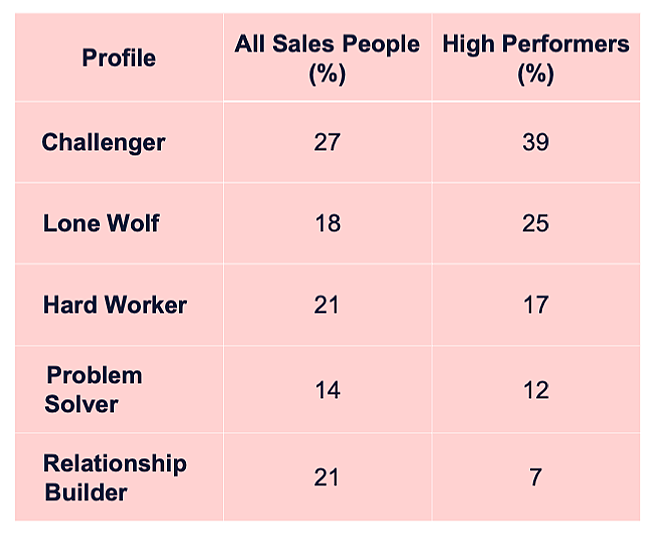
Dixon & Adamson, The Challenger Sale
The Relationship Builder, the profile most organizations celebrate, train for, and promote - is the worst performer in complex sales. Somewhat counter-intuitively, Challengers account for 39% of high performers in long-tale sales. Even higher in more complex sales environments. Relationship Builders account for 7%.
Now consider what most agencies have spent years systematically building: account managers trained to smooth things over, never say no, and keep collaboration frictionless. Modern agency management has been optimized to produce Relationship Builders, the very profile that underperforms in complex selling.
Consulting firms took a different route. Tougher conversations. Sharper people. More candor.
And they were rewarded for it. The four largest advertising holding companies currently have a combined market capitalization of roughly $65 billion, a fraction of Accenture’s. That is not the whole story, but it is not nothing either.
What the Research Actually Says About Relationships
Before anyone accuses me of arguing that relationships and humanity do not matter, let me be precise. The research does not say relationships are irrelevant. It says we have misunderstood what kind of relationship matters.
The Challenger Sale is not an argument against building trust. It is an argument against the thin version of trust built on agreeableness, tension-avoidance, and telling clients what they want to hear. Customers often liked those vendors. They just were not especially persuaded by them.
The more valuable kind of trust is built on intellectual respect. It survives disagreement. Sometimes it is strengthened by it. A client thinks: this person will tell me the truth even when it is uncomfortable. That is trust worth paying for.
One of the most important findings in the research is that 53% of customer loyalty in B2B comes from the quality of the sales experience. Not the product. Not the price. Not the brand reputation. How you engage matters more than most agencies behave as though it does.
Teach, Tailor, Take Control — In Agency Language
The Challenger model is built on three behaviors, and the translation to agency life is not subtle.
Teach means arriving with a perspective the client has not considered. Not answering the brief but instead, reframing it. As Dixon, Adamson, and Nick Toman wrote in the Harvard Business Review, the hardest thing about B2B selling is that customers do not need suppliers the way they used to. Clients have procurement, dashboards, AI tools, consultants, and endless access to information. What they cannot generate on demand is the insight they do not yet know they need.
Tailor means knowing the client’s business, not just their category. P&L literacy. An understanding of what the CFO is measuring, not just what the CMO is worried about. It means understanding the politics, incentives, and fault lines inside the organization.
Take Control means saying no to bad work. It means holding the line when an idea is being sanded into paste. Or when the proposed media approach looks like everyone else’s. Dixon and Adamson call this “constructive tension” - discomfort directed not at the relationship, but at the client’s status quo.
That does not mean aggression. It means being able to say, with evidence and conviction, here’s why I don’t recommend that. And that is precisely where many agencies lose their nerve.
What CMOs Are Saying Right Now
The research is not just historical. The CMOs who are candid about what they want from agency partners are saying the same thing in plain language in SenseMaker’s CMO interviews:
“They're the ones who might say: ‘I hear what you're saying, and I will respectfully think about that, but I don't agree.’ Clients prefer them because they think, ‘Thank you. Someone's got a point of view and a backbone.’”— CMO, global food CPG
“With agencies now I'm thinking, where are you? Why aren't you coming and giving me tools and arming me with ideas and insights, even just asking questions..."— SVP Marketing, Canadian grocery retail
“I’m looking for someone with a wide aperture, strategic thinker and long-term view. More of a risk taker. Someone who will push to make things better. Someone who will challenge me. Push me forward, a new perspective. Good advice.”— CMO, automotive
The Setup, an agency pitch consultancy, has tracked agency-client dynamics for years. Their relationship survey contains a finding that is both encouraging and damning: “agency did not challenge us enough” has been one of key reasons clients end agency relationships. The encouraging read is that agencies willing to challenge are rare enough to be valued. The damning read is that most agencies are still too timid for the issue to register.
Consider the context. Average CMO tenure at large U.S. firms now sits below four years. A marketing leader with a short fuse, a pressured budget, and a board demanding proof of growth does not need a nice agency. They need one that makes them look smart.
The Honest Tension
Dixon and Adamson argue that Challenger behaviors can be learned. That is the optimistic read, and probably true in the aggregate. You can teach people to ask better questions. You can coach them to create constructive tension. But the Challenger mindset goes deeper than training. It's structural.
Agencies must hire for conviction, curiosity, and judgment. They must promote the people who push back, not the ones who merely smooth things over. They must build cultures where productive disagreement is expected, not punished. The 4As, in its 2026 outlook, argues that human capabilities including judgment, cultural insight and storytelling are the real IP agencies will need in the AI era. Those are Challenger capabilities, not relationship-builder ones.
The Agency That Wins
The agency that wins the next decade will not be the one with the best AI platform. Every holding company has one now, or soon will, and they will all start to look suspiciously alike. The agency that wins will be the one whose people can walk into a boardroom, challenge the thinking, and make the CMO feel smarter for having heard it.
The great irony of the Relationship Builder’s failure is that it produces worse relationships.
An agency that tells clients what they want to hear earns comfort, not trust. An agency that tells clients what they need to hear earns something more durable.
All the greats have known this. The research just confirms it.
The question is whether the industry is willing to act on it.