

Advertising Needs More Contrarians.
Part 3 of a series on why advertising agencies are losing the plot — and what to do about it.
We've established that your people are your most valuable asset. The question is: what kind of people?
Some may be uncomfortable with this idea, but I think the best thing that ever happened to advertising was difficult people.
David Ogilvy was famously hard to work for. George Lois was combative. Jay Chiat, mercurial. Sir John Hegarty would kill work that nearly finished if it didn't meet his standards. Laura Jordan Bambach fights what she calls “advertising pollution” and pushes up against the male dominance of the industry. And Susan Credle has been a fierce proponent of creative as a leadership skill, not an organizational construct. It's easy to say these personalities are ego driven; but more importantly they have unwavering standards and vision.
Sure, these leaders are not famous because they're "nice”. They're known as brilliant, opinionated, and constitutionally incapable of being generic. And clients didn't just tolerate them. Clients sought them out. Clients paid premiums to work with them. Clients flew to Portland and London and Los Angeles because they wanted access to a specific mind, a specific sensibility, a specific point of view that they could not get anywhere else. When I posited that few agency people are on a client's speed dial, i was not referring to challenging people like this. These were the type of leaders clients called first when they had a business problem.
That is what a brand is. Not a logo. Not a tagline. A reason someone chooses you over all else.
The Great Dilution
Somewhere in the last two decades, many (larger) agencies decided that personality was a liability. The logic was understandable, if ultimately self-defeating. Agencies were merged to create scale thus losing their founder mentality. Leaders with big personalities were more expensive and difficult to "manage.” And investing in a big name ran the risk of losing that big name - to one of your competitors. So safer executives were put in place.
The thing is, these personalities - difficult as they may be - are a beacon. Clients can spot them. Clients are drawn to them. And isn't it better to attract business than chase RFPs?
The result is a landscape where, as our analysis of 122 Canadian agencies confirms, fewer than one in five agencies can claim genuinely strong differentiation. Unfortunately, holding company agencies have the thoughest time standing out - and therefore probably need a disproportionate share of these kinds of personalities.
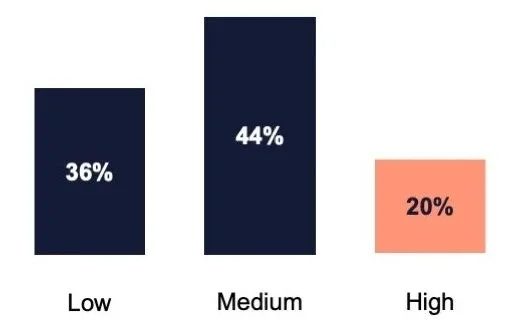
80% of agencies have moderate to low differentiation.
Source: Sensemaker analysis of 122 Canadian agencies.
The Independents Are Winning
Look at who is actually winning new business, earning the best talent, and getting called for the interesting problems. It's largely the independents — and specifically the independents built around people with something to say.
These agencies have something many holding company networks have largely abandoned: a personality. A point of view. A reason to exist that goes beyond a capabilities matrix. My advice to indies: keep amplifying your thought leaders. My advice to network shops: hire a few people at the top that have an informed opinion - and aren't afraid to say it.
The Argument for Difficult People
There is a version of this argument that sounds nostalgic — a lament for a golden age that cannot be recovered. I don't think that's right. The conditions that made Ogilvy and Bernbach and Clow great are still present. Clients still want to work with people who are smarter and braver than they are. The market still rewards genuine distinctiveness and a point of view.
The problem is not that the era of the agency brand is over. The problem is that most agencies have voluntarily abandoned the field. According to the marketers I spoke with, these "difficult” people are either at indie shops, or left the industry all together. But it's not impossible to find them.
Agencies invest 60 to 70 percent of their annual revenue in people — a staff-cost ratio that dwarfs almost every other industry. They have, in other words, already made the investment. The question is whether they are able and willing to leverage it. Whether they are willing to let their people have opinions in public. Whether they are willing to build a brand around a point of view rather than a service menu.
The chair at the head of the table used to belong to someone with a name. It still can.
As it turns out, the research agrees.