

Agencies: Your Most Valuable Asset is Hiding in Plain Sight
Last week, I asked a simple question: when a client has a real problem — the kind that keeps them up at night — who do they call?
The uncomfortable answer, for most agencies, is that they call someone else. A consultant. An internal resource. A former colleague. Someone with a point of view they trust.
There is a reason for that. And it has nothing to do with capability. The truth is, agency talent isn't top of mind for most clients.
Here is a number worth sitting with: advertising agencies invest 60 to 70 percent of their annual revenue in staff. The staff-cost ratio in retail rarely exceeds 40 percent. In most manufacturing industries, it is under 20 percent. By any measure, the people inside an agency are not just the largest line item on the P&L — they are, by a significant margin, the single most important investment the business makes.
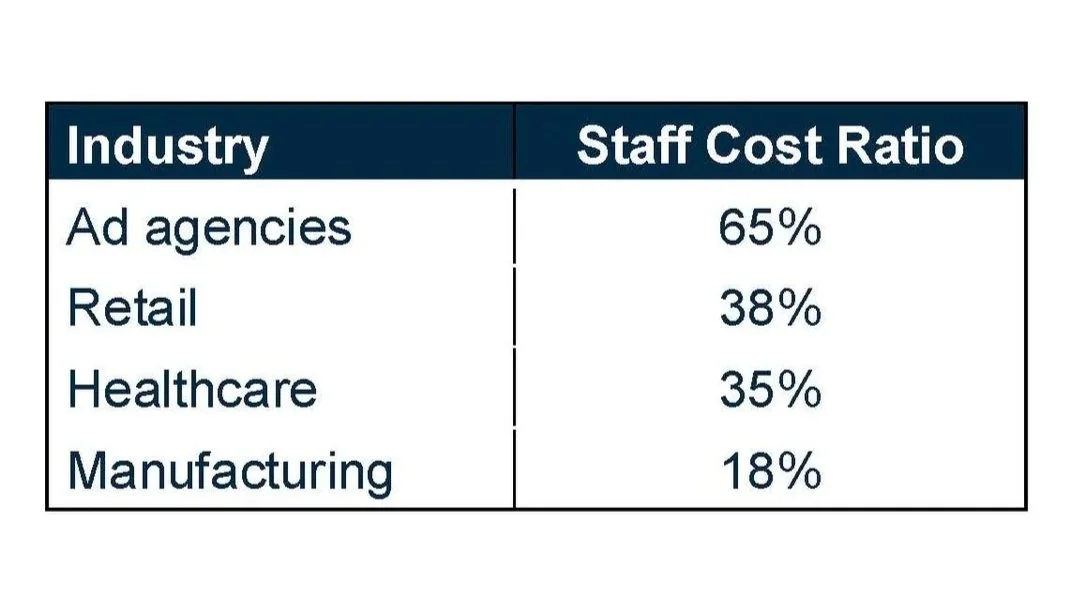
Source: Industry benchmarks. Ad agency SCR per 4A's and IPA data.
Now visit most agency websites. What do you find? A list of services. Digital. Strategy. Creative. Social. Content. Sometimes "integrated." Sometimes "full-service." Occasionally, if the agency is feeling adventurous, something about "human truths" or "cultural relevance." No wonder that in a study Sense.Maker conducted among 122 agencies nearly 80% had modest to low differentiation.
The people — the actual humans who represent 60-plus percent of the agency's investment — are buried in an "About" section, if they appear at all. Their names are in small type. Their personalities are invisible. Their points of view are nowhere.
This is not just a missed opportunity. It is a strategic failure of the first order.
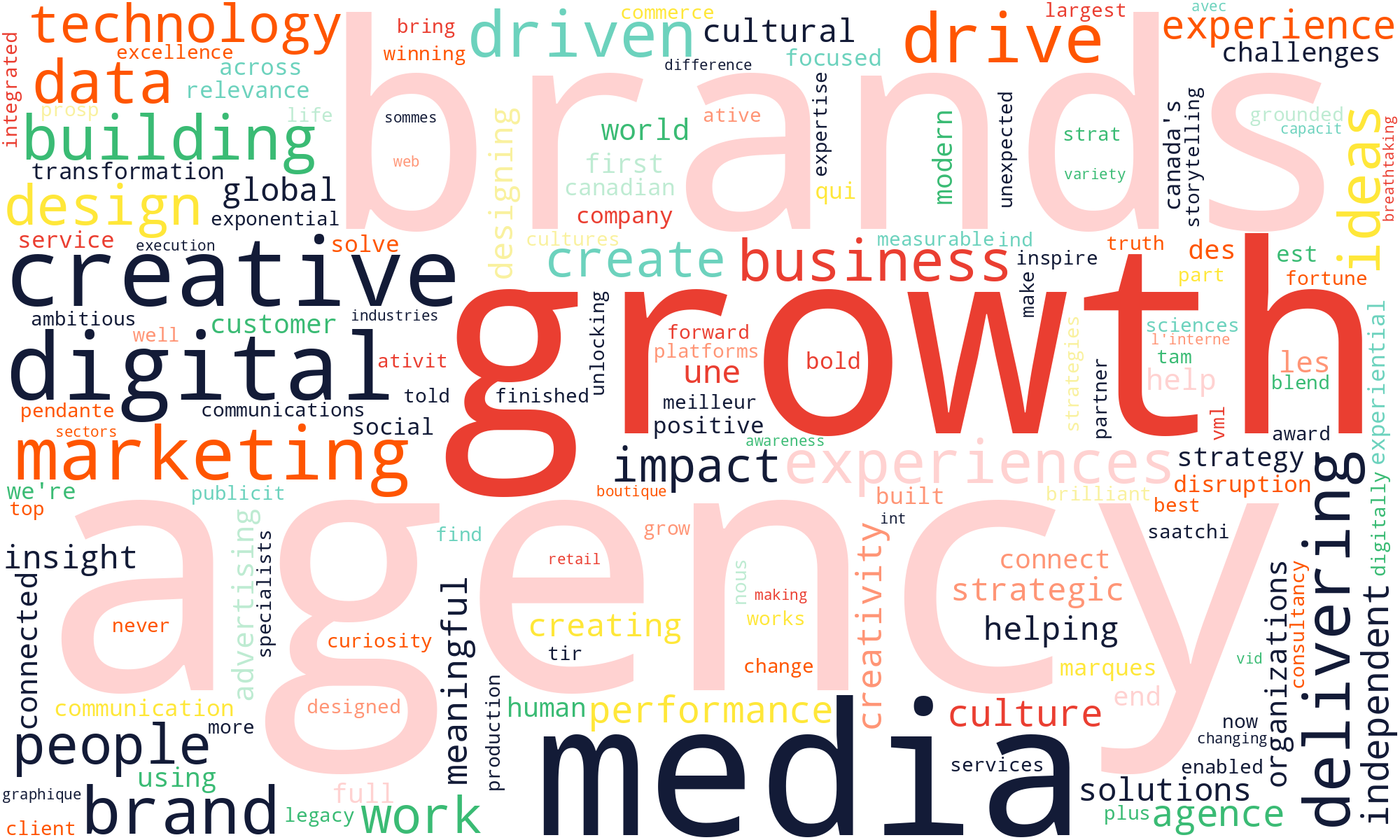
Most common words found in agency self-promotion materials and quotes.
The Hollywood Parallel
Think about Hollywood's golden age. The major studios — MGM, Paramount, Warner Brothers — operated on a contract system. They signed actors, directors, and writers to long-term deals. They trained them, promoted them, and invested heavily in building their public profiles, because they understood something fundamental: the talent was the product. Audiences didn't go to see "a Paramount film." They went to see Humphrey Bogart, or Katharine Hepburn, or a film directed by Howard Hawks.
The modern agency equivalent would be to pay Margot Robbie $50 million for Barbie and then bury her name in the appendix of the pitch deck. That is, more or less, what agencies do with their creative talent every day.
The agencies that understand this are winning. I don't need to name the shops with vocal, respected leaders. They not only speak their mind, they demonstrate what their company brand stands for. The person and the brand are inseparable, and that inseparability is the point.
Intellectual Property in a People Business
The consulting industry has something to teach here. McKinsey publishes research. Deloitte builds practice areas around named experts. BCG has fellows whose thinking is associated with the firm's brand. These organizations understand that in a knowledge business, the people are the intellectual property — and intellectual property needs to be actively managed, developed, and marketed.
Agencies, by contrast, tend to treat their talent as fungible. A creative director leaves and is replaced by another creative director. A strategist moves on and another strategist fills the role. The institutional knowledge walks out the door, and the agency's brand — such as it is — remains unchanged, because it was never built around people in the first place.
This is a choice, not an inevitability. Agencies could invest in developing their people as public thinkers. They could build platforms for their talent to publish, speak, and be known. They could treat the development of a recognizable creative or strategic voice as a business priority, not a personal indulgence. They could, in short, brand their intellectual capital the way every other knowledge business does.
The Practical Argument
Our analysis of 122 Canadian agencies found that the shops with the strongest differentiation scores share a common characteristic: they are associated, in the market's mind, with specific people and specific points of view. This is not a coincidence. It is a business model.
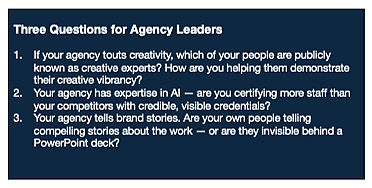
If your agency touts creativity, the question is: which of your people are publicly known as creative experts? If you claim expertise in AI, are your people building visible credentials in that space? If you tell brand stories for clients, are your own people telling compelling stories about the work?
The answer, for most agencies, is no. And that is precisely the opportunity.
The most defensible competitive advantage in a commoditized market is not a new service offering. It is not a new technology platform. It is a distinctive human voice that clients recognize, trust, and seek out. You have already paid for it. The question is whether you are willing to use it.
But visibility alone is not enough. The next question — the harder one — is whether the people you are making visible actually have something worth saying. Whether they have the conviction, the point of view, and the willingness to be difficult that makes a client want to call them when it really matters.
That is a different problem entirely.
And it is the one we need to talk about next.