

The Barbell Agency
Agencies and Marketers need to kill the billable hour.
The future is the barbell, not the pyramid.
The advertising industry is good at worrying out loud.
The trade press has read like an obituary for five years straight. It reminds us that margins are squeezed, clients are pulling work in-house, AI is eating the junior ranks. And the work is slop. Sure, for some this is true. But most agency leaders blame the rain for the leaky roof.
The rain just exposed the neglect.
The agency model isn't struggling because of algorithms. It's struggling because it was built on an embarrassing premise: charge clients for 1800 person-hours per year and work staff 2,500. Selling billable hours encourages larger teams at a time when clients want efficiency and outcomes.
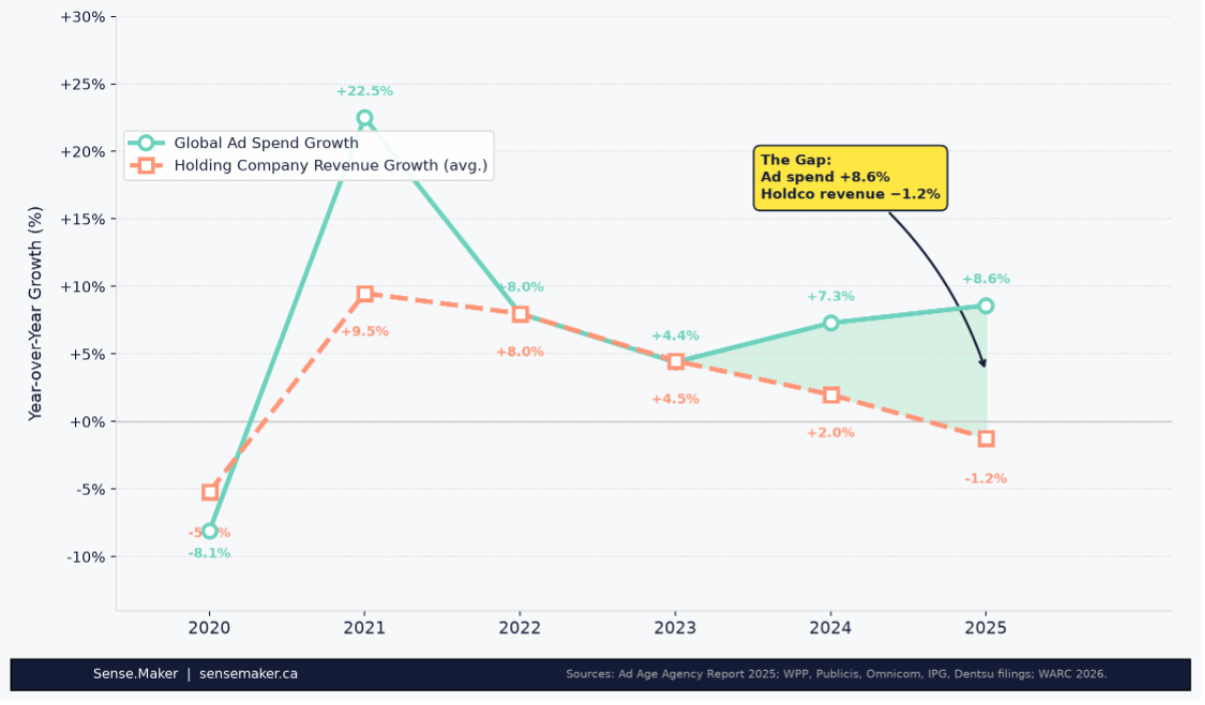
Ad Spend vs. Agency Holdco Revenue Trend
And now clients are paying attention. While spending is up, agency revenue is declining.
GroupM's mid-year forecast projects global ad spend reaching $1.3 trillion in 2026. Meanwhile, WPP's revenue dropped 5.6 per cent in the first half of 2026 after an 8.1 per cent fall in 2025. The Omnicom-IPG merger has eliminated more than 8,000 roles since closing, with further cuts projected through 2027. Spend is growing. Agency revenue is shrinking. And with it, Networks’ once-robust net margin is now single-digit.
The gap between increased spending and declining agency performance is the broken model.
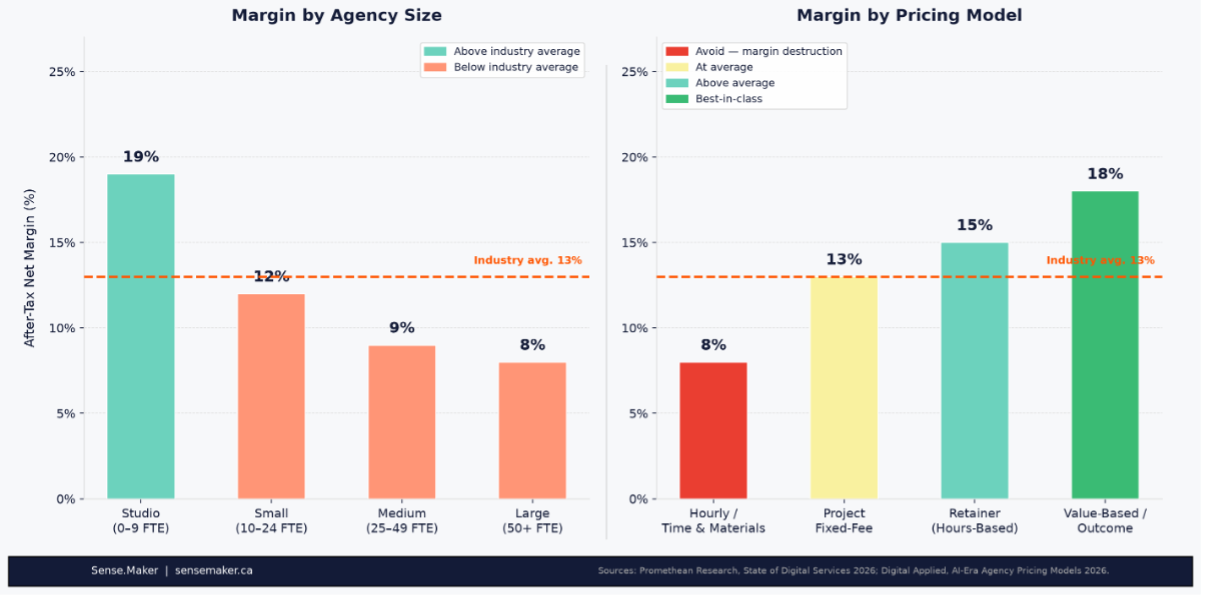
Margin by Agency Size vs. Margin by Business Model
Scissors are not tools of reinvention.
Cutting won’t fix this gap. Agencies need to tear down the pyramid. build the barbell.
The traditional agency structure is a pyramid: a broad base of junior staff, a thick middle of supervisors and account managers and a thin sliver of senior talent at the top. The math always seemed to work because juniors were cheap. That math no longer holds.
An AI agent can execute a competitive audit, write contact reports and workback schedules and draft briefs for pennies in minutes - work that once consumed and billed hundreds of junior hours. And yet 98 per cent of agencies now use AI tools while almost none have redesigned the commercial model around them. The result: firms with more than 50 employees average eight per cent net profit. At that margin it’s hardly worth the effort.
The agencies winning right now are not fighting the tide. We are seeing successful shops tearing down the pyramid entirely and building a barbell.
On one end of the barbell, you have senior thinkers, strategists, and creative talent. These are the people who own judgment, human insight, and client relationships. These agencies hire the best and pay competitively.
On the other end, you have skilled operators (Agent Managers versus Account Managers) directing autonomous workflows to handle execution at speed – insight mining, administration, briefs, decks and reports. They write prompt. Know which models do what tasks best. Manage token-cost like others manage staff cost.
The bloated middle is gone.
The economics are straightforward. A 10-person client team with fully loaded payroll of around $1.5 million can be restructured into a six-person hybrid pod of senior humans and AI agents at a delivery cost of approximately $924,000. A 38 per cent reduction in cost with no loss in capacity.
More importantly, it changes who is in the room. Fewer executors. More thinkers. And that, finally, is the justification for pricing that reflects the strategic value.
Three shifts that protect your margin:
First, stop selling time and start selling outcomes or deliverables. The retainer built on hours defies logic. The more efficient you get, the more your margin shrinks. A hybrid model, a base fee for human judgment plus an outcome incentive tied to business results or delivery is the commercial logic that protects margin as execution costs fall. And if a client resists agents on their team, charge a premium for fully-human teams rather than a discount for automation.
Second, move from departments to guilds. Silos are incompatible with modern integration. Organize talent (human and agentive) into cross-functional skill sets of strategy, creative, data, and operations that share a P&L and get paid on the outcomes they deliver, not the hours they log.
Third, hire for judgment, not output.BCG projects that 50 to 55 per cent of US jobs will be reshaped by AI within three years. The first-draft writer role is already in decline. The agencies that win won't simply be the ones cutting junior positions. They will be the ones actively recruiting people who know exactly where the machine stops and human creativity begins.
The liberation inside the disruption
Here is what gets lost in five years of industry hand-wringing: AI commoditizes routine, not judgment. Or great thinking. Or great work.
For the first time in 20 years, agencies have a genuine path to charge what great strategic thinking is worth. The filler work, the steps between steps, the work that was never really the work, is gone. What remains is the part of this industry that matters: empathy, craft, cultural instinct and human connection.
The holding companies have the resources and restructuring machinery to make this happen – albeit not quickly. Indies may not have the reserves, but they also don't carry the legacy overhead, management bloat and shareholder pressure that paralyzes the networks.
Either way, cutting and kvetching will not bring about the rewiring needed to thrive.
The agencies moving now will set the pricing, the talent standards and the commercial logic for the next decade. The ones waiting for consensus will inherit whatever is left.
The rewire is not a threat. It is the most interesting brief this industry has seen in a generation.
What structural changes is your agency making right now? I'd like to hear what's working.
Arthur Fleischmann is the founder of Sense.Maker and brings experience as co-founder of john st., Group CEO of Ogilvy Canada and WPP Country Manager for Canada.