

Why the Canadian Agency Market Looks Like a Traffic Jam
You're building a brand. Why settle for a commodity agency partner?
If you're a CMO right now, you're operating under pressure that would make a lesser person rethink their career choices. The latest Deloitte/Duke University CMO Survey shows economic pessimism is high, budgets are flat or shrinking and your CFO is relentlessly pushing for immediate ROI. You're being asked to protect long-term brand equity while driving short-term performance, all while figuring out how to "scale AI" with internal processes that are nowhere near ready.
So when you go looking for an agency partner, you'd hope the market gives you something to work with.
It doesn't.
We recently mapped the top 25 creative agencies and top 20 media agencies in Canada. We used public evidence only: agency websites, case studies, executive interviews, trade coverage, awards and client work. A service listed on a website only moved an agency's position on the map if there was consistent public evidence of that capability being deployed.
The resulting maps are striking - not for their variety, but for the lack of it. They cluster.
On the creative map, nearly a quarter of the market is huddled in the dead centre. On the media map, half the core agencies are jammed into the middle. Like a traffic pile up.
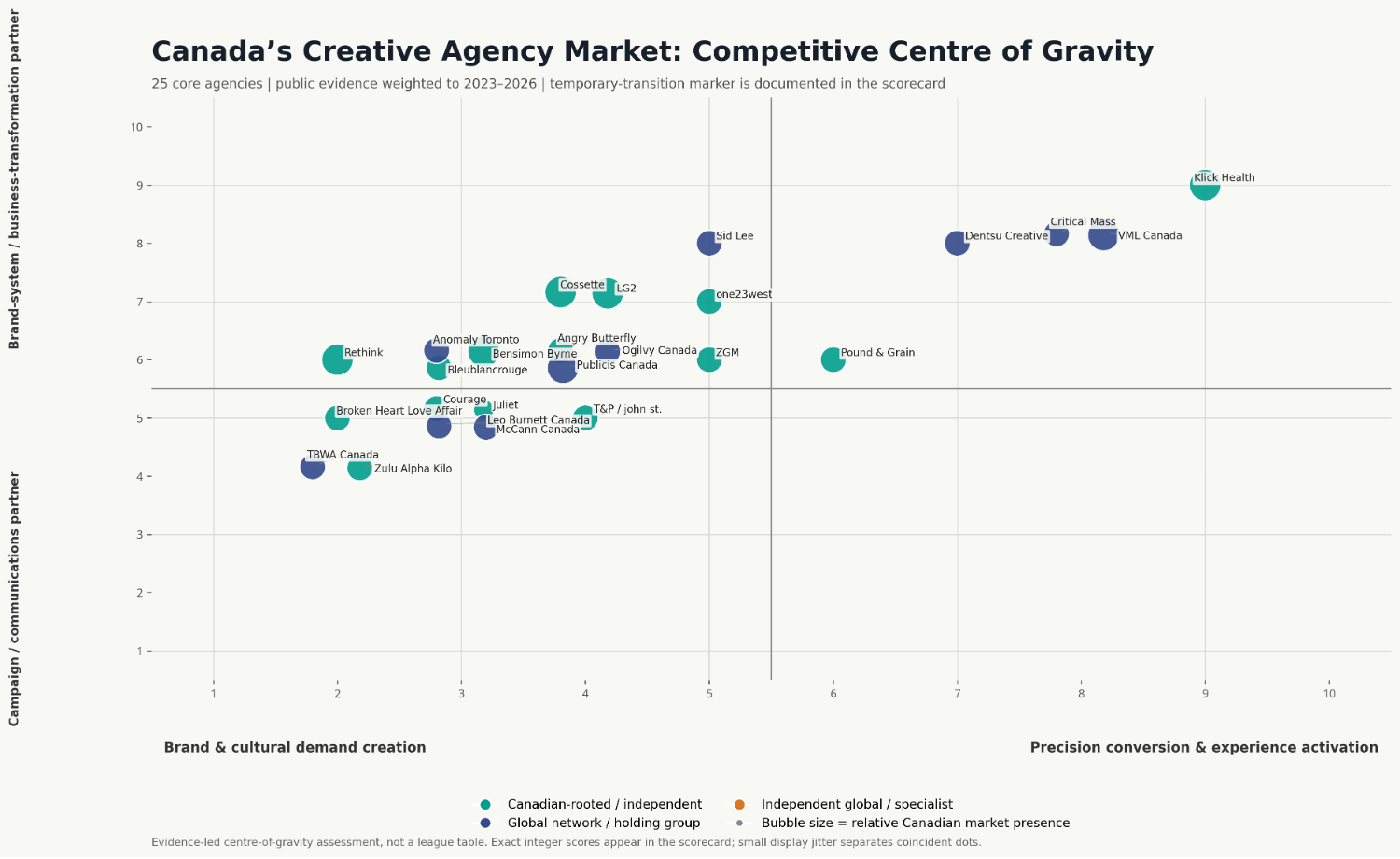
Creative Agencies Competitive Map
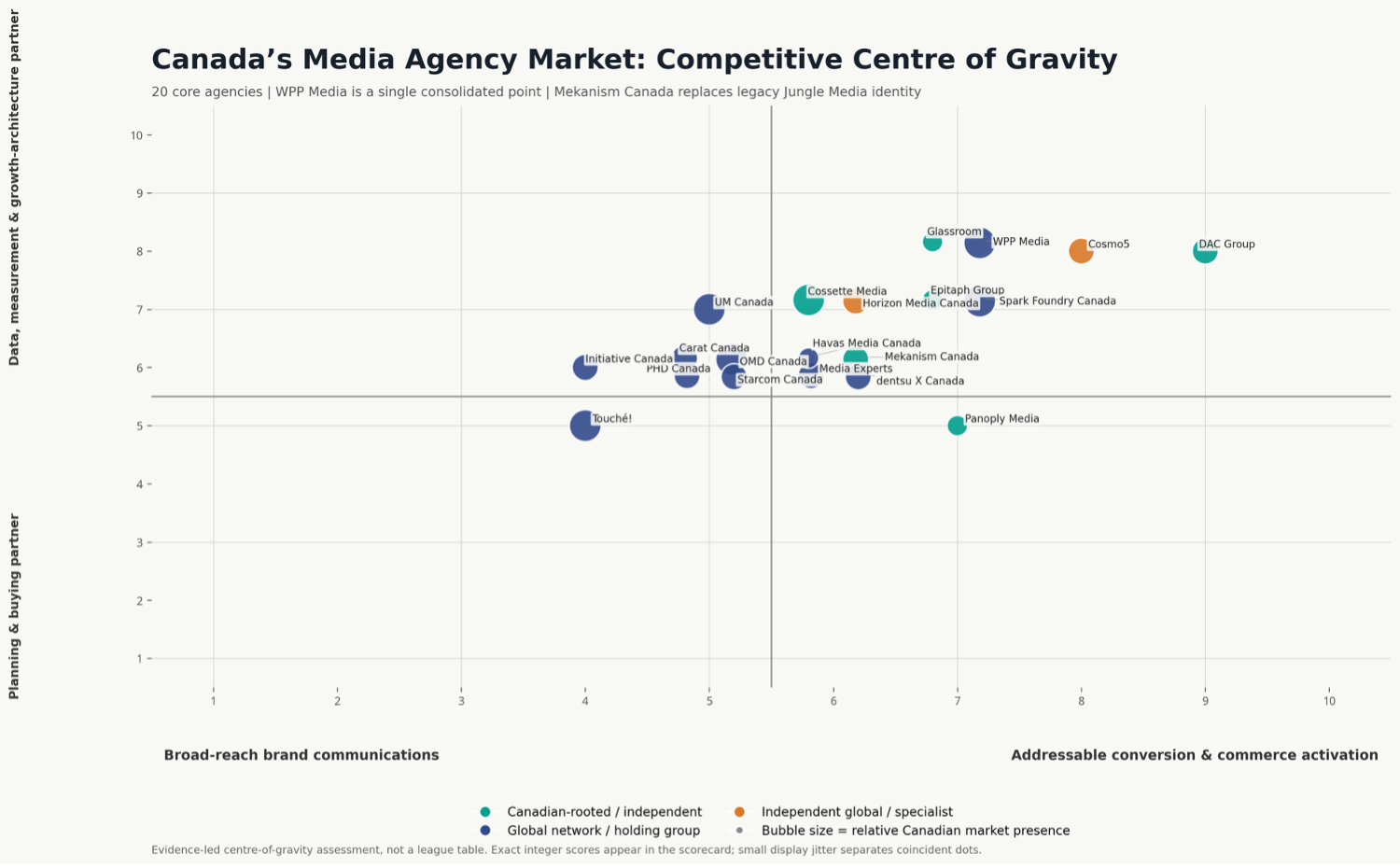
Media Agencies Competitive Map
This is the vocabulary trap. Every agency claims to be "integrated." They'll tell you they build brands, drive growth and transform businesses with the latest tech. And because everyone's saying it, none of them are saying anything. "Integrated" isn't a positioning. It's a baseline expectation - like a restaurant advertising that they use ingredients.
The industry has retreated to the safety of the middle because agencies are terrified of missing a pitch due to a missing keyword. So they claim everything, prove nothing and leave you, the CMO, to stitch together the strategy, the media, the creative and the data architecture yourself. That is exhausting, inefficient and genuinely risky.
Three questions that cut through the noise
Before you hire, renew or brief an agency, test whether their claims are reality or aspiration. These three questions will reveal their true commercial gravitas.
1. The trade-off test
Ask them: "If my CFO cuts our budget by 20 per cent tomorrow, what do you recommend we stop doing?"
An agency trying to be everything will suggest trimming everything by 20 per cent - preserving their scope while keeping everyone mildly unhappy. Or they'll tell you to cut content and performance. A genuine strategic partner will identify the least commercially efficient activity, even if it's their own work and recommend cutting it entirely to protect your core growth engine.
While you're at it, ask which they think is your least commercially efficient activity. The answer will tell you everything. No budget can do everything. The best partners make the commercial choices visible and governable.
2. The measurement trap
Ask them: "How will you prove that our brand investment is making our performance marketing cheaper?"
The industry is saturated with short-term attribution models. If an agency can only offer last-click reporting, they don't understand how demand creation actually works. The real test of a capable partner is whether they can build a measurement architecture the CFO will believe - one that connects long-term brand equity to near-term conversion. Are they conversant in marketing mix modelling (MMM)? Do they have direct experience with it or are they just nodding along?
This question separates the strategists from the order-takers.
3. The growth diagnosis
Ask them: "What commercial problem are you built to solve that the agency next door is not?"
This is my favourite. The market is saturated with phrases like "moving at the speed of culture," "brand storytelling" and "big ideas." If their answer is a string of nouns - "we combine data, creativity and technology" - they are stuck in a vocabulary trap. But if the answer is a specific mechanism such as "we are built to find pricing power in commoditized categories" your ears should perk up. They may actually be on to something.
Stop issuing RFPs. Issue a Request for Realignment.
Everyone has the nouns. What you're looking for is a demonstrated mechanism of value creation.
Are they fundamentally built to drive cultural demand or precision conversion? Do they deliver campaigns or can they credibly help you drive a growth strategy? If your current agency roster feels like a collection of vendors and buzzwords rather than a strategic growth system, the problem isn't the agencies. It's the brief you gave them.
Standard RFPs produce standard responses. They reward the polished pitch over the proven point of view. If you want strategic partners who can connect brand investment to commercial outcomes, ask the questions that expose how they think not just what they offer.
It might be time to stop issuing RFPs altogether. It might be time to issue a Request for Realignment.
At SenseMaker, we help marketing leaders navigate these exact challenges and align agency ecosystems with commercial reality. If you're tired of managing the friction, email me at arthur@sensemaker.ca to book a 20-minute call. Let's talk.